El Cobre

The most important shrine for Cubans and most famous church in the country is lodged in the foothills of the Sierra Maestra near the old copper mines that give it its name. The triple-domed church with the mouthful name of El Sanctuario de Nuestra Señora de la Caridad del Cobre, built in 1927, rises on Maboa hill and is photogenically framed by green forest. The faithful come from across Cuba on pilgrimages to pay their respects to (and ask for protection from) a black Madonna, the Virgen de la Caridad (Virgin of Charity).
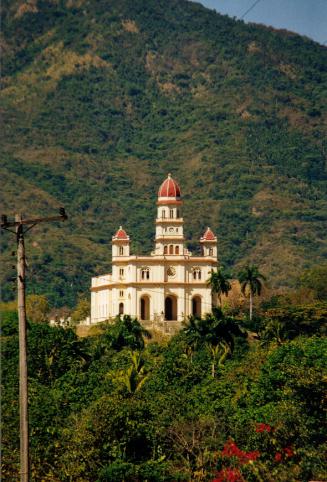
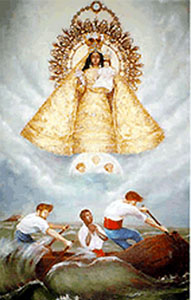
She is nothing less than the protectress of Cuba, and her image, cloaked in a glittering gold robe can be seen throughout the country. Her parallel figure in Afro-Cuban worship is Ochún, goddess of love and femininity, who is also dark-skinned and dressed in bright yellow garments. In 1998 the Pope visited and blessed the shrine, calling the Virgin "La Reina de los Cubanos" (Queen of Cubans), and donated a rosary and crown.
According to legend, Cuba's patron saint was rescued bobbing in the Bay of Nipe in 1611 by three young fishermen (or miners, depending on who's telling the story) about to capsize in a storm. The Madonna wore a sign that read YO SOY LA VIRGEN DE LA CARIDAD (I am the Virgin of Charity). With the wooden statue in their grasp, they miraculously made it to shore. Pilgrims, who often make the last section of the trek on their knees, pray to her image and place mementos (votos) and offerings of thanks for her miracles; among them are small boats and prayers for those who have tried to make it to Florida on rafts. Ernest Hemingway -- whose fisherman in The Old Man and the Sea made a promise to visit the shrine if he could only land his marlin -- donated his Nobel Prize for Literature to the shrine, but it was stolen (and later recovered, but never again to be exhibited here). The Virgin sits on the second floor, up the back stairs, encased in glass. When Mass is being said, the push of a button turns the Virgin around to face the congregation. The annual pilgrimage is September 12, and the patron saint's feast day is July 25. The Basílica is open daily from 6am to 6:30pm; admission is free.
You can take a taxi to El Cobre for $20 to $30 round-trip. The no. 2 bus runs between Santiago and El Cobre four times daily, leaving from the main bus station in Santiago. To enhance the spiritual experience, or to merely have a serene and incredibly cheap overnight stay, there's an inn behind the church, Hospedería de la Caridad, which welcomes foreigners who abide by the strict rules; a stay costs a mere 10 pesos a night (38¢), although they generally charge foreigners a few dollars. There are only 15 austere but well-kept rooms; it's necessary to reserve by phone (tel. 22/3-6246) at least 15 days in advance.
Cachita ..."La Virgin de la Caridad"
Around 1600, 2 Indian boys, found a 30cm high wooden statue of a black virgin in the Bay of Nipe. On her left arm she was carrying the child Jesus and in her right hand she held a golden cross. The statue had the inscription :"Yo soy la Virgin de la Caridad" (I'm the Virgin of Mercy)
In 1608 the statue was brought to mine village. She got famous of projecting freedom, doing wonders, gives consolation and heals wounds after wars. In 1916 the pope canonize her to the saint of protection.
Many pilgrims go to this basilique to pray to Cachita daily, but most crowded is this place at September 8, when there is a proccession and a statue of Cachita will be carried around the village.
In Santartia religion, Chachita is dressed in yellow called Yoruba the goddess of love and dancing
Inside the Basilique people left a lot of relics, you will be impressed what people left behind in the hope Cachita can solve their problem or to be with them.
Outside you can buy all kind of souvenirs, buy a little bag of copper-pieces from the El Cobre mines and carry one piece always with you, after giving the other pieces to your best friends for having luck
|