| Trinidad

One
of Cuba's Juwels
The
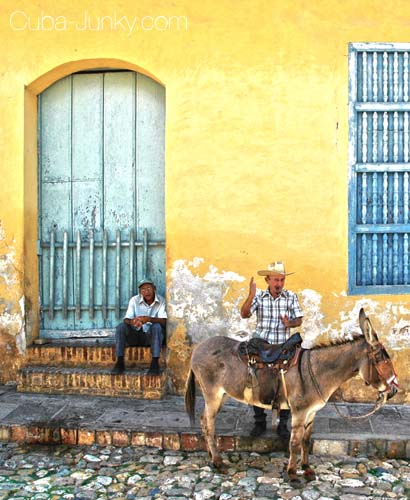
first time I came in this city I thought:"I can make 5000 pics
in this place ...
Beautiful historical center with red roofs and streets of little
bricks
This city is full of the hirtory of colonial Cuba.
The old historical center of Trinidad is the best to see by feet,
cars aren't alowed anyway, you can park your car
at Calle Antonio Maceo
Thousands of slaves got trade from this city to other islands of
the Caribbean
In 1988 UNESCO declared Trinidad "World Monument"
Ancon
and Maria Aguilar Beaches
 |
In
addition to its lush natural surroundings and colonial appearance,
Trinidad is graced by the sea, which gave it two excellent beaches:
Ancon and Maria Aguilar, both of which are very close by and
are among the best beaches on the southern coast of Cuba. Ancon
Beach is just a little over 7 miles (12 km) from the city. It
is two and a half miles (4 km) long, with white sand and green-blue
water. Its seabed is ideal for scuba diving and spearfishing.
|
The
Ancon Peninsula is bordered by a narrow shelf of sandy bottom, with
colorful patches of coral, ridges up to 16 and a half feet (5 meters)
high, tunnels and other features. It has 21 scuba-diving sites,
where you can see concentrations of Black Coral (Antipathes spp.),
a wide varietay of spnges, gorgonians, Common Sea Fans (Gorgonia
spp.) and many kinds of colorfull fish.
Location
and How to Get There
The
Ancon Peninsula is slightly over 7.5 miles (12 km) from Trinidad
(232.5, or 375 km, east of Havana, in the middle of the country).
Modern roads link the city to the city
of Sancti Spiritus, capitol of the province of the same
name, and to the city of Cienfuegos
(25 miles, or 40 km, away). A large part of the road to Cienfuegos
hugs the coast and offers some beautiful views. There are three
national airports in Sancti
Spiritus Province. The one serving Trinidad handles the
most flights-of small and medium sized planes-and links that city
with other important tourist resorts in the country.
What
to Do
 |
Activities
include lazing in the sun, swimming, snorkling, scuba
diving and other water sports; seafaris and excursions
to nearby cays; deep-sea and bottom fishing; tours of the oldest
part of Trinidad and of its surrounding area, including Sugarmill
Valley and Topes
de Collantes, in a large area of parks and natural
preserves; excursions to Cienfuegos; visits to beaches along
the road to that city; and trips to other tourist resorts in
the archipelago. |
For
evening entertainment, there are many recreational options which
can be combined with the offers in Trinidad.
Accomodation
and Facilities
 |
There
are 3 hotels on the
Ancon Peninsula: the 3-star, All-Inclusive,
Club Gran Caribe Ancon; and the 3-star Horizontes
Costasur;
The 4 star Brisas
Trinidad del Mar. All three are on the beach, with
a total of over 500 airconditioned rooms, each with satelite
TV. The hotels also have swimming pools, restaurants, gyms,
bars, tennis courts, discoteques and a family atmosphere. |
In
Trinidad , there are at least six other urban and rural hotels and
villas, plus an international clinic. A scuba
diving center on on the Ancon Peninsula will fit you
out with the equipment you need for enjoying this beautiful caribbean
beach to the full.
The
Ancon Peninsula also has a marina with scuba diving equipment. It
offers seafaris to cays in the area; bottom, trolling and deep-sea
fishing; and services for living on board in the Jardines de la
Reina Archipelago: mooring services, anchorages, drinking water,
electricity, commissary service, fuel, bathrooms with showers, and
a bar-restaurant.
 |
Nearby
Places of Interest
UNESCO
declared Trinidad (founded in 1514, the third Spanish settlement
in Cuba) to be a part of world cultural heritage because of
its colonial architecture, which dates from the 18th, 19th
and early 20th centuries. The oldest part of the city (55
blocks in size, with 1211 buildings) is one of its greatest
attractions. |
It
contains beautiful churches (such as the Great Parish Church, a
neoclassical edifice built in 1892) and public squares, the most
important of which is Main Square-surrounded by buildings of great
beauty and historic and architectural interest and considered the
second most important square in the country, after Havana's Cathedral
Square.
Trinidad
has several museums: the Romantic Museum and the Museum of Architecture,
Archeology, History and the Struggle against Counterrevolutionaries.
One Mansion, built in 1723 sells souvenirs and
special drinks typical of the city: canchancharas (for which the
house is named), a cocktail made of honey, Lime juice and high wine.
The city also has a Troubadours House (Casa de la Trova) and a House
of Music (Casa de la Musica). In the evening, there's a discoteque,
several bars and folkdance performances.
 |
A few miles from
Trinidad, going up a steep mountain road, you'll come up to
Topes de Collantes Natural Park.
Some 2625 feet (800 meters) above sea level, up in the mountains,
it has a cool microclimate. The streams and rivers in its valleys
go underground to drain, and dozens of species of plants and
animals live here. They include colorful birds, ferns, precious-wood
trees and orchids, many of which are endemic. Here, too, you'll
find beautiful waterfalls-such as Caburni Falls, which drops
from a height of nearly 200 feet (60 meters) into a pool fed
by several springs. |
There is a 4-star tourist complex,
the Escambray Kurhotel, with
more than 200 rooms, a gym, a heated swimming pool and other facilities,
an ideal base for all who love hiking, bird watching, horseback
riding, swimming in crystal clear rivers, spelunking and visiting
sites which combine nature with farm traditions and delicious Cuban
cuisine.
Sugarmill Valley-which UNESCO also
declared to be a part of world hertiage- is just a few minutes drive
frim Trinidad. Here, you can see ruins of sugarcane plantations
dating from the 19th century, with sugar pans, towers, wheels (gear
wheels) and even some of the mansions built by the aristicracy of
that era, such as the "big house" at the Guaimaro Sugar
Mill, which has Italian frescoes, wooden balustrades and round-arched
windows. The tower of the Manaca Iznaga Sugar Mill, known as Iznagna
Tower, is still standing. It has seven levels and is nearly 143
feet (43.5 meters) high. Then take another mountain road to reach
El Nicho Park, with its impressive waterfalls, endemic flora and
birds, caves and pools where the swimming is great.
| |
| Antigua
Villa de la Santísima Trinidad |
Centro
Histórico Urbano
Trinidad
|
| Bazaar
Trinidad |
Calle Antonio
Maceo
|
| Brunet
Theater Ruins |
Brunet
Theater was inaugurated in 1840. The house became the
center of the local culture until 1901, when the roof
fell down.
The theater was scenery for famous performers as Armentas,
Robeño, Adelina Valti and Juventino Rosas.
|
| Casa Regidor |
Art Gallery
|
| Casilda |
Harbor
|
| Centro
Histórico de Trinidad |
 |
Patrimonio
Mundial Trinidad |
When
the sugar mills of the Valle de Los Ingenios ceased
producing profits in the mid 19th century, Trinidad
became an dark provincial town. Its inhabitants had
no choice but to keep, their sumptuous belongings, including
wooden balustrades, stylish furniture and the elegant
architecture of their homes. Touring the city today
is a journey back on 19th century paved cobble stone
streets to glimpse the physiognomy from the 18th century
in its buildings. Restoration work has further pronounced
this time warp by repairing the murals, which embellished
palaces and mansions.
|
| Embalse
Hanabanilla |
Weir lake
|
| Iglesia
Parraquial de la Santisima (The Holy Trinity Church) |
 |
|
Better
known as Parroquial Mayor, anno 1892. The interior is
very simple Victorian-Gotical with an impressive altar
beautifully decorated. According to bibliographical
accounts, it was in that church where the first Baptismal
registration of a white people took place in 1514. Its
altar made of finest wood substituted the traditional
marble.
|
| The
Manaca- Iznaga Tower |
Industrial-vernacular-style building embedded in a Cuban
typical landscape.
Its construction was finished late in 1830’s or
early 40's. Built to be a watch tower to monitor the
sugar mills. The 43,5 m-high building is Cuba's only
type, and has a 184-step stair to climb to its top.
|
| Mesón
del Regidor (The Tavern of the Regidor) |
A mansion from the first half of the 18th century. Former
residence of the town's Regidor Ortiz. Its mural is
believed to be one of the city's first ones. Today one
of the most cosiest hotels in Trinidad
|
| Museo de
Arqueología y Ciencias Naturales |
| Simón
Bolívar #457
Trinidad
Tel 419 3420
A
18th-century building remodeled in 1835. It became a
museum in 1976.
Exhibitions variates from Pre-Colombian culture to local
flora and fauna, sometimesa bit boring. The German explorer
Alexander Von Humboldt stayed in this house during his
trip to Cuba in 1801.
|
| Museo de
Arquitectura Colonial |
Plaza Mayor
Calle Cispalda #83 e/ Cristo y Plaza Real del Jigue
Trinidad
Tel 419 3208
(closed on Friday)
Former
mansion of the Sánchez Iznaga family. It was
built in 1738, and restored in 1836. The 18th-century
household opened as the Museum of Architecture of Trinidad,
in 1979.
|
| Museo Historico
Principal |
 |
Bolivar
#423, e/ Francisco Gomez y Gustavo Izquierdo
Trinidad
Tel 419 4460
(closed on Friday) |
| A
stylish furnished building. It will tell you the history
of all kind of historical objects. From the tower you
can take stunning pictures of Trinidad center.
|
| Museo Romántico
|
Fernando
Hernández Echerri #52, near Calle Simon Bolivar
Trinidad
Tel 419 4363
(closed on Monday)
Lowded
with antique furniture, witnesses of the wealthy 18
century in Trinidad. As well as inside the building
itself, beautiful tiles!
|
| Museo de
la Lucha Contra Bandidos |

|
Fernando Hernández
Echerri #59 close at Piro Guinalt
Trinidad
Tel 419 4121
Open Hours: 9am-5pm Tue-Sun
(closed on Monday) |
This
museum is located in the former convent and church of
San Francisco de Asís, built in 1770 and finished
in 1913. During the first decades of the 20th century
it was demolished and only its tower remained. It was
later rebuilt as it appears today. In 1986 the convent
became the "Museum of the Struggle against Bandits".
Documents, photos, maps, weapons and belongings of the
main participants in these battles are exhibited.
|
| Plaza
Carrillo (Carrillo Square) |
Became
a relevant place for entertainment and leisure in 1840,
after a process of organization in the city of Trinidad
took place during the 18th century. Since then, the
square has been paved, grated and also restored totally.
Several important buildings of the city surround it
as the current headquarters of the local Government.
|
| Plaza Mayor
|
Since
Trinidad's beginnings and like most cities founded by
the Spaniards—the relevant institutions were clustered
round the city's central plaza. From 1514 onward, this
plaza has undergone changes, until more than 300 years
later it finally took on its present appearance. During
the 19th century, the main Cathedral as well as mansions
and palaces of the landed families of Brunet, Padrón,
Ortiz and Sánchez-Iznaga's were situated here.
Today, most of these building house museums and the
plaza is quaintly decorated with four gardens surrounded
by fences from Philadelphia, street lamps and a statue
of the Greek muse, Terpsicore, in its center.
|
| Plaza
de Santa Ana (Saint
Ana Square) |
Ancient
Royal Jail built in 1844.
At present, it is a cultural center of great significance
in the city.
|
| Polo Viejo |
Sitio
histórico
Trinidad
|
| San
Francisco de Assisi Convent |
It
started to be built in 1770, and concluded in 1813.
It was demolished earlier last century, when only its
tower survived. However, some years later it was rebuilt
under its original design. In 1986, the convent finally
became the Museum of the Cuban People's Struggle against
the Counterrevolution.
|
| Semana
de la Cultura Trinitaria |
These
past few years Trinidad's cultural week has been celebrated
during the second week of January. The date was moved
to coincide with the commemoration of the city's founding.
Throughout the seven-day long festivities, the city
displays its best cultural traditions. Artisans, potters
and painters exhibit their best work. Locations around
the city open their doors for concerts and folkloric
groups perform outside of their usual stages.
|
| The
Three Crosses neighborhood |
Its urbanization began during the 18th century along
with the expansion of the city.
Its real name is Calvary neighborhood. Although today
is name is The Three Crosses Plaza. The Three Crosses
neighborhood becomes a relevant place in Trinidad during
the traditional religious processions of the Holy Week
|
| Topes de
Collantes |

|
Beautiful nature in
the Escambray mountains.
Many tourist offices in Trinidad can help you for a
tour to this great area of Cuban nature.
-
More >> |
Torre del Antiguo
Ingenio Manacas-Iznaga |
Carretera
de Trinidad a Sancti Spíritus
Trinidad
Pedro
Iznaga built a sprawling hacienda in the middle of the
San Luis Valley with the fortune he made from the slave
trade. He erected a 44-meter high watch tower with 184
steps, some 50 meters from the main house, to control
the slaves who were more than willing to escape. He
would also mark the hour by tolling a bell. The vernacular
and industrial-style tower has become a symbol of this
legendary region, despite its contrast with the surrounding
area. It does in fact allow for a panoramic view of
Trinidad.
|
| Valley
of the Sugar mills |
A
World Heritage Site. This beautiful green plateau was
home for old sugar mills.
The Valley is a wonderful Cuban landscape outstanding
for its archaeological and architectural treasures,
as well as its areas of incredible wilderness.
|
|
| Banks |
Banco de Credito
y Comercio
Marti #164 |
Post Office |
Centro Llamando
Maceo #418 |
Phone |
Tele Center
General Lina Prez #274 |
Emergency |
General Hospital
Maceo |
Servimed Clinica
Internacional Cubanacan
Lino Prez #103 |
Optica |
Óptica Miramar
Trinidad
Martí No. 321, Casa del Joven Trovador,
Trinidad |
Shops |
Aeropuerto Trinidad
Tienda Departamental
Carretera de Casilda,
Trinidad |
Ancón
Tienda Departamental
Hotel Ancón, Trinidad |
Casa del Tabaco
Tabaquería
Francisco Zerquera No. 304
Trinidad |
Casa del Tabaco
Trinidad
Tabaquería
J. Martí No. 296, Trinidad |
Casilda
Tienda Departamental
Real, Casilda, Trinidad |
Cochera Brunet
Tienda Departamental
Simón Bolívar No. 501,
Trinidad |
Costasur
Tienda Departamental
Hotel Costasur, Trinidad |
El Campesino
Tienda Departamental
Carretera a Cienfuegos,
km. 1, Trinidad |
Gaviota
Tienda Departamental
Hotel Los Helechos
Trinidad |
La Canchánchara
Tienda Departamental
R. Martínez Villena No. 74,
Trinidad |
Las Cuevas
Tienda Departamental
Hotel Las Cuevas
Trinidad |
Manacas-Iznaga
Tienda Departamental
Carret. de Sancti Spíritus,
km. 12, Trinidad |
Mesón del Regidor
Tienda Departamental
Simón Bolívar No. 312,
Trinidad |
Mini Super La Delicia
Mercado
F. J. Zerquera No. 7,
Trinidad |
Photoservice
Trinidad
Fotografía
Hotel Ancón, Trinidad |
Santa Ana
Tienda Departamental
Camilo Cienfuegos s/n
y J. M. García, Trinidad |
Tienda ARTex
Playa Ancón
Música
Hotel Ancón, Trinidad |
Trinidad
Tienda Departamental
Antonio Maceo No. 442,
Trinidad |
Trinidad
Centro Comercial
José Martí s/n, e/. Rosario
y Colón, Trinidad |
| Interesting
Trinidad links: |
|
|
|