| |
Havana Province
Capital
City:
La Habana
Havana Province,
province of Cuba's capital, beaches at Playa del Este,
Marina Hemingway Harbor, Cojimar and many many small towns
to explore.
|
Havana
Province Information |
| East
of Havana City & Beaches |
 |
Bacuranao,
Megano, Boca Ciega, Santa Maria and Guanabo Beachesthe
last two are the largest and most popular-are
over eight and a half miles (around 14 km) long,
white white sand of coral origin and clear, warm,
green-blue water. There are many options for accomodations
and services, including the Tarara Marina, which
has facilities for
scuba diving and other water sports.
The adjacent seabed is facinating, with abundant
Flower Coral (Eusmilia fastigiata) and Brain Coral
(Diploria spp.) and a profusion of vividly colored
fish that live near coral.
|
In the deeper water,
you can see turtles, Blue Marlins (Makaira nigrencans),
Tuna (Scombridge) and Sword fish (Xiphias gladius).
In general, the city's long shoreline is excellent
for scuba diving-there are more than 70 diving sites
in this area 62 miles (100 km) long and nearly two
miles (3 km) wide, including some sunken ships which
have been declared a part of Cuba's historic heritage.
Four international scuba diving centers serve the
capital.
Still
farther east, in Havana Province, beautiful Jibacoa,
Tropico and Puerto Escondido Beaches continue the
series, their white sand bordered on the landward
side by lush vegetation and cliffs up to 328 feet
(100 m) high and on the seaward side by incredible
green and blue water.
-
Map of Havana's Playas del Este >>
-
Scuba Diving >>
|
| West
of Havana City |
| 
|
West
of Havana, the Marina Hemingway Tourist Community
offers the most complete range of marina facilities
in the country. Still farther west, in Havana Province
again (city of Havana is bounded by Havana Province
to the east, south and west), tranquil El Salado
Beach, protected by coral reefs, has more scuba
diving sites.
|
Location
and How to Get There |
| Bacuranao,
Megano, Boca Ciega, Santa Maria and Guanabo
Beaches are on the northern coast of Cuba around
12 and a half miles (20 km)-just a few minutes'
drive-east of Havana, on the way to
Matanzas Province. Havana is the
main place of entry in the country, either by
air-trough Jose Marti International Airport
(which has three terminals, plus an Aerocaribbean
terminal, and receives flights
from more than 40 cities in other countries)-or
by sea trough its marina and the modern cruise
ship terminal at the port. Tourists visiting
other parts of the country can reach Havana
by road, rail, sea or air.
-
Rent a car online >> |
How
to get to Guanabo (Playa del Este) according to the
Lonely Planet:
"I
took the #400 bus to GUANABO beach last Monday and
wrote down the instructions for my sister who will
visit next April. The current guide books are not
current on this bus.
 |
Find
the bus shelter on the north side of "Fundicion"
between "Compostela" & "Picota"
in old Havana . This is east and south of the
front of the central railroad station. It is
the origin point of this bus and presents the
only chance you will have of getting a seat.
Find
the guy who hands out the little cards for seats,
otherwise you WILL STAND the whole way out.
Find out who El Ultimo is and follow him/her
onto the bus. Lines are RELIGIOUSLY OBSERVED.
Do not deviate from his procedure! Sit on the
left side to see the shore.
Fare
is 40 centavos. Frequency in daytime is apprximately
20-30 minutes. Duration of trip is approximately
one hour. Other busses serve Playa del Este,
but this is the best choice.
|
-
Check
out the Viazul bus schedule to get to the Playas del
Este >>
| What
to Do? |
| There
are scores of activities, both at the beaches
and in the city. They include swimming, sunning,
snorkeling, scuba
diving and other water sports (windsurfing,
pedal boating, sailing and rowing); going on
excursions along the shore; fishing; tennis,
squash, beach volleybal and other land sports;
tours of the city; visits to museums and to
other places of historic, cultural and recreational
interest; and going on excursion packages to
other tourist resorts in the archipelago.
Thousands
of people come to Cuba on health, conference
and incentive tourism plans. Others come to
attend international festivals or to sample
the islands'night life in clubs,
cabarets, discotheques and nightclubs.
|
| Accommodations
and Facilities |
 |
The beaches have
many modern hotels. Havana
itself has more than 60 hotels, tourist
complexes, inns, villas and spas, most of them
of 5, 4 or 3 stars, with air-conditioned rooms,
satelite TV, internet, safes and other features,
depending on their category. The hotels also
have swimming pools, gymnasiums, beauty parlors,
massages, saunas and jacuzzis; restaurants with
a wide range of cuisine, bars, grills and cafetarias;
and
dicoteques, clubs, cafe's and cabarets.
|
The
other hotel features include child-care services,
doctors on call 24 hours a day, a solarium, art galleries,
shops, tennis courts, facilities for other sports,
game rooms, buses, rental cars, taxis and other means
of transportation. Some of the hotels have special
rooms for people with disabilities. There are museums,
boutiques, shopping malls, cigar shop, drug stores
and facilities for scuba
diving and other water sports.
Choose
between accommodations
on the shore; in the outskirts of the city; or right
in Havana-in the oldest part of the city,
in one of the residential areas or in areas with plenty
of greenery. Havana
has several international clinics and drug stores,
Houses of Habanos and cigar shops, speciality shops
in many spheres and shopping malls. It also has a
large network of restaurants, bars and cabarets, discotheques,
cafe's and clubs; handicrafts fairs, florist's, jewelry
stores, liquor shops, photoservice shops, fashion
houses, banks, messenger services post offices and
conference centers (the largest and most inportant
in havana's International Conference Center, but there
are several others, and many of the hotels also have
conference halls). For transportation
choose among taxis, horse-drawn carriages, rental
cars and rental air-conditioned campers.
| The
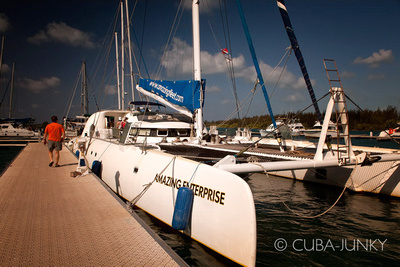
Tarara and Hemingway Marinas are both near Havana:
Tarara Marina to the east, and the Hemingway Marina
to the west. The latter has
first class accommodations, a shopping
mall, several restaurants,
a modern recreation room, facilities for stocking
up on drinking water and provisions, repairs,
a ship chandler's, nautical charts, weather information,
Customs and immigration offices, boat rentals,
a beauty parlor and a fitness center. |
|
| Havana
also has four international scuba-diving centers
and many other options. |
| Alamar
A
typical suburb of Habana is "Alamar",
build after the revolution, by Russians. 5
story high, looking very sad, buildings where
in earlier times Russian techniques where
living. Nowadays way too many people are living
in those buildings. In this town is also living
Esperanza
Berena Feria Pacho, she makes
beautiful small figures from raw materials
like
insects, reptiles, birds, etc.
Links:
|
| Alquízar
|

|
Casa Natal
de
Rubén Martínez Villena
92 No. 8427, e/. 84 y 86, Alquízar
|
|
Artemisa
Artemisa,
founded in 1818, is named after the Greek god of fertility,
Artemis. Artemisa is the among the most interesting
towns on the route between the cities of Havana and
Pinar del Río. Artemisa is also the largest,
with a population of roughly 160,000.
Artemisa
is an attractive and vibrant town with the quintessential
Cuban mix of well-preserved neoclassical-style, pastel-painted
buildings featuring ornate columns in the Doric and
Ionic styles.
The
setting of Artemisa is certainly an urban one, but
it also provides a rustic taste of Cuban country life,
as it is a thoroughfare for farmers on horseback.
Historically,
Artemisa has been a strong cultural center, and that
tradition continues today. The city is home to one
of the province's most active Casas de la Cultura,
the state-sponsored facilities for plays, music, and
other cultural activities.
Artemisa
is home to a number of interesting museums, most of
which are dedicated to the 24 Moncada attackers (out
of 150 in all) that came from Artemisa.
Museo
de Historia
Martí, e/. Mártires y Agramonte,
Artemisa |
Mausoleo
a los
Mártires de Artemisa
40, e/. 45 y 47, La Matilde, Artemisa |
Ruinas
del antiguo
cafetal Angerona
Km. 5,5, Artemisa-Cayajabos,
finca Sousse, Artemisa |
|
Bacuranao
The beach is famous
for locals and the busiest it will be there in July
and August
|
Batabano
Bananas….bananas
and bananas….or in better Spanish, platanos. Watch
out for farmers who are protecting their fruit for
people who want to steel it and sell the platanos
at the black market.
Batabanó
is one of the seven cities originally founded in 1515
by Velasquez' men, and was the original Spanish site
of Havana. It was actually called San Cristóbal
de la Habana for four years before present-day Havana
was established about 30 miles north.
Today,
Batabanó has a population of about 15,000 people.
Like many of the small towns in the southern part
of Havana province, Batabanó is a depressing
place. Eastern-bloc architecture looms over the swampy
landscape, and there is not much in the way of interesting
sights to see.
Batabanó
does feature excellent sponge diving. Its primary
trade is fishing, as it is very near the southern
coast. It also serves as the port to Isla de la Juventud
(Isle of Youth, also called Isle of Pines).
"Surgidero
de Batano" is also famous about the fishing of
lobsters and shrimps, so for having a great fishy
diner…this is the place to go….lots of
good small fish restaurants.
"Museo
Municipal", at Calle 64 #7502
|
| Bauta |
Sitio Histórico
Lombillo
Bauta |
Antiguo
Ingenio Taoro
Carretera de Punta Brava
a Santa Fe, Bauta
|
|
Bejucal
In 1835 was this the
place where they ended the first railway, build by
African slaves, Spaniards from the Canary Islands,
and some Irish people. Those people worked for 16
hours a day at that time, for a really lousy salary.
|
Casablanca
The picture everybody
knows, who ever has been in Habana before, of the
big white marble statue…"Estatua de Cristo",
if you ever want to make the best view picture of
Habana city, take a ferry to this side of the city
and climb up that hill..
|
Cojimar
This is where most
tourists stop…the fishers village Cojimar is famous
because of "Ernest
Hemingway", you can find more information
on the "Ernest
Hemingway" page In 1994 thousands
balseros raft across the sea to the US after they
heard on a radio broadcast they could get asylum…more
about this in the "Balseros
page"
|
El
Megano
16 km AFTER Cojimar,
the real beaches with sand and palm trees is starting
at El Megano.
|
Guanabacoa
Famous about his African
Cuban religious, you can find information about the
"Santaria religion". The outside neighborhoods
of the center are looking really poor. A great day
to be there is on Sunday, when a lot of street merchants
try to sell their stuff on the main plaza "Calle
Amargura" is famous because of his history about
slaves which where brought to their execution. Really
worth a visit "Museo Municipal de Guanabacoa"
at Marti #108 Iglesia de Guanabacoa. On parque Marti,
in the center "Cemetery of Guanabacoa".
Another great place to see, a real city of all kinds
of beautiful mausoleums "Galeria de Arte Concha
Ferrant" atMarti #8. "Casa de la Trova"
Marti #111. Great place with daily life music, you
find "Casa de la Trova/Musica" all around
Cuba
|
Guanajay
Casa de Carlos Baliño
61 No. 7205, e/. 72 y 88, Guanajay
|
Güines
Güines
exists since the XVII century, since at that time
an Indian by the name of "Guzmán"
built there the first catholic church, made of straw
and mud. The second one, made of wood and with a tiled
roof, was built by the Bishop of Havana in 1804. Today's
church, made of concrete and of solid construction
was started in 1815, but with two towers. In 1870
a hurricane destroyed one of its towers. In 1872,
the remaining tower was demolished, and the church
was rebuilt with only one tower, the one that exists
today, gracious and attractive. The patron saint of
Güines is St. Julián, whose feast is celebrated
on January 28.
Guines
website >>
| Cueva
de la Candela |
Cueva
de los Perros Jíbaros |
| Cueva de la
Palma |
Cueva de García
Robiou |
Ruinas
del antiguo
ingenio Alejandría
|
|
Jaruco
South of Guanabo, a
beautiful nature parque, at the highest top, at "Campo
Florido", there is a restaurant and a hotel.
|
Madruga
In this village is
a "Santaria"
house open for tourists. Madruga is very proud of
his original American buildings. North east of Madruga
you will find the, started in 1917, sugar factory
"Camilo Cienfuegos"
Madruga also has a
special "bond" with CJ.com because of the
Madruga project. More about this at our Help-Page
Loma de la Gloria
Loma de la Gloria s/n,
esq. a Copey, Madruga
|
Managua
The town Managua, with
lots of traditional houses with patio's full decorated
with plants. This area has a lot of military camps.
Lots of "Ceiba trees" are growing, some
very old ones, holy in some African
religions and because of that reason
they never will be cut.
|
Mariel
Established
in 1762 as a British naval station during the British
occupation of Havana, the port of Mariel has become
an important city for commerce and industry on Cuba's
northern coast.
During
the 18th century, Mariel was the site of a British
naval station and academy. The town of Mariel was
founded by local fishermen somewhat after the British'
arrival. Since the 1959 Revolution,
the city Mariel has received considerable attention
from the Cuban government, which has helped it to
earn the important status in commerce and industry
that it holds today.
Mariel
houses Cuba's largest cement factory, as well as a
relatively new thermoelectric plant, textile factories,
and a significant array of shipyards. Besides pouring
money into industrial development, the government
established many new housing, educational, and medical
facilities to improve the workers' standards of living.
In
recent years, Mariel was the focus of international
attention during the famous Mariel Boatlift and resulting
US-Cuban tensions. The crisis occurred when a group
of Cubans living in Havana discovered a diplomatic
loophole that would allow them to flee Cuba be seeking
political asylum in the Peruvian Embassy. They were
followed by thousands of anti-Castro dissidents, relatives
of exiled Cubans, and others seeking refuge in the
U.S.
Then-U.S.-President
Jimmy Carter welcomed the refugees warmly, lifting
normal restrictions and requirements for their entrance
into America. While Castro
must have been embarrassed that so many people sought
to leave his country, he used the situation to his
advantage, getting rid not only of his political opponents,
but also sending "undesirable" elements
- the mentally insane, violent criminals, as well
as others. This move caused President Carter a great
deal of embarrassment in the U.S. and placed him in
a very submissive position.
|
Pan-American
Village
Very close to Cojimar
you find a complex for sport facilities, apartments
and a hotel. This area was build for the Pan American
games of 1991, the people who builded the place ones
are living they're now
|
Regla
Across the Habana Vieja
Harbor, very Afro-Cuban
religious area. If you would like to
visit a "babalawo" (santaria priest) this is the place
to go, although you have to speak Spanish. Go and
take a walk along the market (Marti) where you can
buy Cuban food for pesos instead of dollars, great
place to meet locals. Also in this town the secret
men society "Abakua" are living. Cubans call those
men "Nanigos". "La Santisma Virgin de Regla",
she is the spirit (Orisha) of the ocean, protecting
the sailors. You can see her in the "Iglesia de Nuestra
Senora de Regla" when you take a ferry across the
harbor. At September 7th at this place is a pilgrimage.
" Museo Municipal de Regla" at Marti #158
|
Santiago
de las Vegas
"El
Cacahual", The final resting place of Antonio
Maceo, he was a black general and hero from the first
independence war. "El Ricon Santuario de San
Lazaro", The most importend western pilgrims
center of Cuba In the night of December 16th more
then 50.000 Cubans come to visit this place to get
rid of evil spirits. On Sundays it can be quiet busy.
Aids Sanatorium, between Santiago de Las Vegas and
El Ricon. Opened in 1986, Cubans who are HIV positive
are treatend here and will stay for a few weeks, after
this they can decide to go home, but a lot stay because
the health care could be much better here then in
their own home town.
The
Cuba AIDS Project
Was founded in 1995.
Alberto Montano (1953- 1999), as Executive Director,
was instrumental in the formation of the Cuba AIDS
Project. While in Washington, D.C., in 1995, Alberto
met with President Clinton and discussed his plans
to help Cuban HIV/AIDS patients. After Alberto's untimely
death, current members of the Cuba AIDS Project expanded
People To People Contacts between the USA and Cuba
in compliance with recent changes in USA policy.

-
For more info see: http://www.cubaaidsproject.com
>>
|
San Antonio
de los Baños
Town of the nearby
"International School of Film", Students
from Africa, Asia and Latin America are having colleges
in this school. San Antonio, also famous about his
"Festival of Humor" (April), there is
even a "Museo del Humor" at Calle 60 at
Av 45, in an old colony house. Symbol of this city
is "El Bobo" (the fool), a cartoon drawn
by Eduardo Abela, was a protest cartoon, in the
Batista years. Post office at Calle 41 and 64
Museo
del Humor
60, esq. a Ave. 45, San Antonio
de los Baños |
Galería
Eduardo Abela
58 No. 3708, San Antonio
de los Baños |
Casa
de los Marqueses
de Campo Florido
60 No. 4116, esq. a Ave. 45,
San Antonio de los Baños |
|
Santa
Cruz del Norte
The town of the oldest
rum factory in Cuba "Ronera Santa Cruz", Havana Club,
which is still one of the best Cuban rums. It was
in 1878 that the Arrechabala family of Cardenas started
this factory in 1919 At the coast, Literal Norte beach,
with some rocky swimmingpools, at El Abra and Arroyo
Bermejo
|
San
José de las Lajas
Cueva de Los
Matojos
Carretera de La Ruda a
La Charca, San José de las Lajas |
Cueva del Aguacate
Carretera de La Ruda a
La Charca, San José de las Lajas |
Cueva de los
Muertos
Carretera de La Ruda a
La Charca, San José de las Lajas |
Cueva del Agua
y
Sitio histórico
San José de las Lajas |
Cueva del Jia
Carretera de La Ruda a
La Charca, San José de las Lajas |
Cueva del
Toro
Carretera de La Ruda a
La Charca, San José de las Lajas
|
|
Santa
Maria del Rosario
A real
charming town with high trees, old houses and friendly
inhabitants, just off the freeway at El Catao. "Iglesia
de Nuestra Senora del Rosario", Also called "Catedral
de los Campos de Cuba" (Cathedral of the Cuban
Countryside) Best to visit Sunday afternoon at 14.30,
when this Cathedral is in action. On the other side
of the square is the rebuilded house of the "Count
of Casa Bayona", the old owner of the Quiebrahacha
sugar factory. "Casa de la Cultura", About
the legends of this region
|
| Diving
|
Puerto Escondido
Cubamar
Carretera Panamericana, km. 80, Jibacoa |
Blue
Reef
Cubanacán Náutica
Carretera Panamericana, km. 23,5, Caimito
|
|
| Harbour |
Puerto Escondido
Cubamar
Vía Blanca km. 80
Santa Cruz de Norte
|
|
|
|