To Do in Bayamo
Casa Natal de Cespedes
Calle Francisco Maceo #57, Bayamo, Granma, Cuba
Tel: +53 23 423864
At the north side of the plaza you will find Casa Natal de Céspedes, the birthplace of the "father of the Cuban nation," is the only house on the square that escaped destruction from the fire. The significance of it alone being saved is not lost on Cubans.
Nowadays it is a museum, open Tuesday through Friday from 9am to 5pm, Saturday from 9am to 2pm and 8 to 10pm, and Sunday from 10am to 1pm; admission is $1.
The house has been lovingly restored; the two-story building holds a chronological exhibit about the Céspedes family, elegant 19th-century colonial furnishings, objects belonging to Céspedes (such as his ceremonial saber), and a few odds and ends that help piece together the story of Bayamo's independent streak (including the original printing press that produced the first newspaper of free Cuba, El Cubano Libre, in 1868).
Céspedes is remembered for refusing to trade his surrender for the life of his son, who was captured by the Spanish army; the Cuban patriot replied in writing that all Cubans were his sons and he could not be expected to trade their independence for the life of one man. The Spaniards promptly shot his son Oscar.
Antiguo Ingenio Pilar de Jucaibama
Monument
Carretera a Mabay, km 4, Bayamo, Granma, Cuba
Casa de la Nacionalidad Cubana
Plaza del Himno #26, Bayamo, Granma, Cuba
La Catedral de Bayamo
(La Catedral del Santísimo Salvador)
Jose Joaquin Palma #130, Bayamo, Granma, Cuba
An immense, ochre-colored, 16th-century church that succumbed to the 1869 fire. Rebuilt several times over the course of its life, the church was recently magnificently restored. It features a high peaked wood-beam ceiling, and above the altar, an attention-getting battle mural commemorating a pivotal local episode when the parish priest blessed the rebel army flag.
This blurring of the lines between church and state was not the only overtly political statement to take place in the cathedral; the first singing of the revolutionary anthem was staged here in 1869. The cathedral is open to visitors daily from 9am to 1pm and 3 to 5pm. To one side of the cathedral, the small chapel Capilla de La Dolorosa (Chapel of the Lady of Sorrows), which dates to 1630, is distinguished by a lovely Moorish-style carved wooden ceiling and fine baroque altarpiece.
Conjunto Arquitectónico de la Plaza del Himno
The main square of Bayamo, also the Plaza del Himno which has gotten its name after La Bayamesa, the National anthem of Cuba
Museo Nico Lopez
Near Abihail Gonzalez, Bayamo, Granma, Cuba
Iglesia Parroquial Mayor de San Salvador
When Nationalists of Bayamo decided to concur the Spaniards they burned down this Parroquiral de Mayor San Salvador all arts got lost. A beauty to visit with includes a chapel build in 1740. The Cathedral is a very unusual with tropical elements and fruits decorated church from the 18th century.
Museo Provincal
Calle Maceo #58, Bayamo, Granma, Cuba
The visit to this provincial museum turns out to be highly interesting. It is located across from the park of Bayamo and near the birth home of the Father of the Homeland, Carlos Manuel de Céspedes, also a museum. The exhibition provides an account of the historical burning of the city, when in 1869 its inhabitants preferred burning it down to giving it over to the Spanish troops. Other documents of the museum are highly important in the formation of the Cuban nationality.
Parque Céspedes
Parque Céspedes is the focal point of downtown Bayamo. It's an exquisite, peaceful square flanked by tall royal palm trees. The light blue and pink building at one end of the square, which today houses a pharmacy, is where the great blaze began. At one end of the plaza is a marble bust of the independence fighter Perucho Figueredo that carries the words and music to La Bayamesa (later the national anthem), which implores followers not to fear "a glorious death" and encourages Cubans that to "die for the homeland is to live." On the other side is a stately granite and bronze statue of Carlos Manuel de Céspedes. Ringing the square are handsome, pastel-colored, arcaded colonial-style (post-1869) buildings. Had the city not been consumed by fire, in all likelihood it would resemble the remarkable colonial core of Trinidad. |

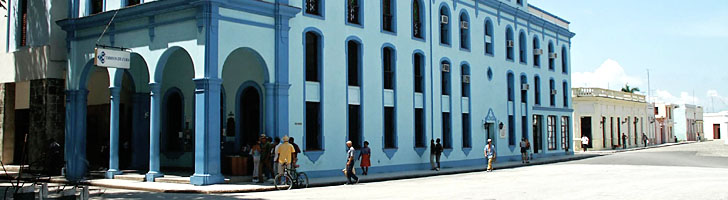 Capital City of Granma Province Population 128.000 Lots of coaches to ride people around the city. Lots of monuments because of its historical background of fighting for freedom of slaves around 1868.